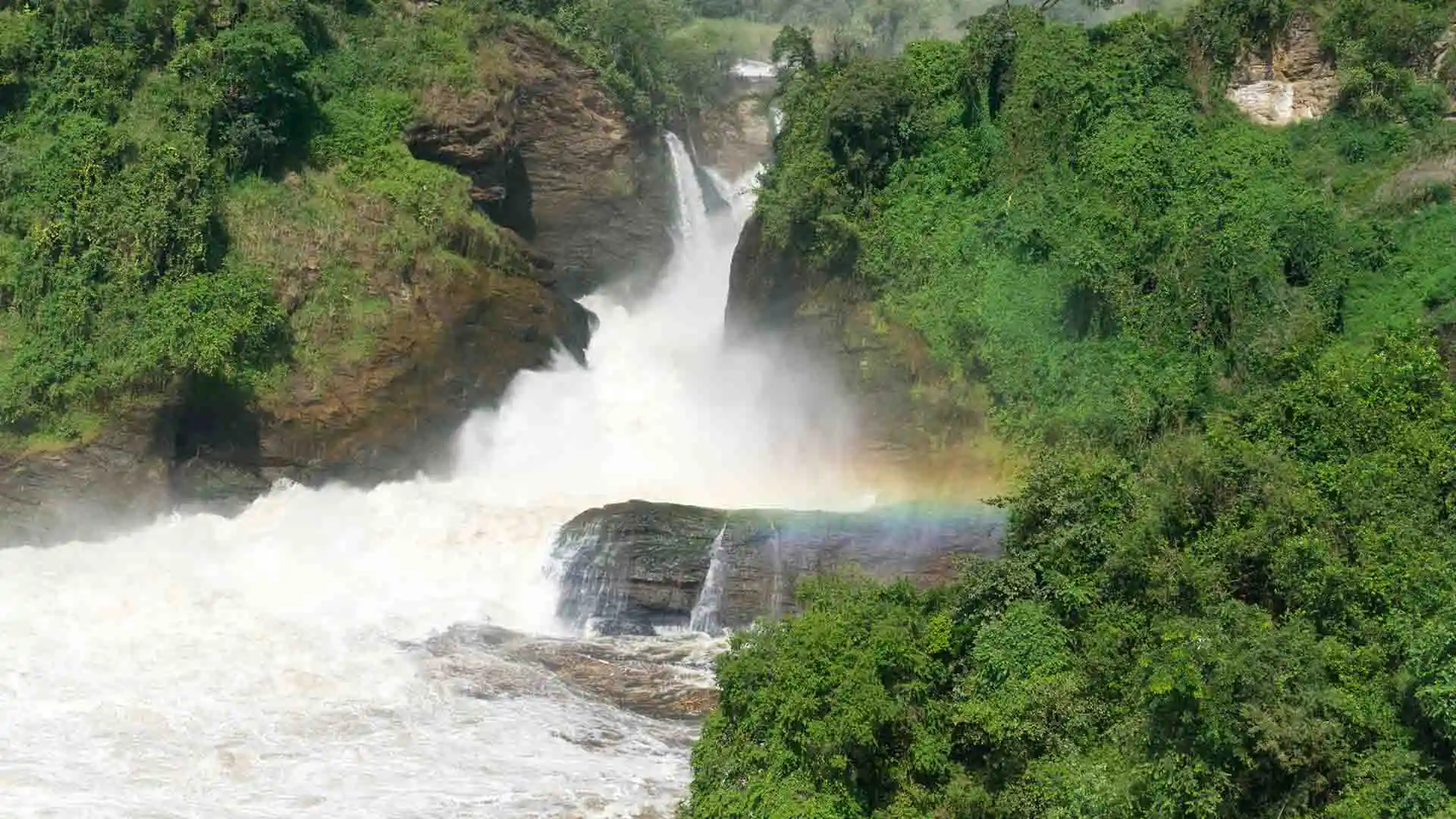
Murchison Falls National Park is the largest national park in North Western Uganda, covering approximately 3,840 to 3,893 square kilometres.
The park spans districts of Nwoya, Buliisa, Masindi, and Kiryandongo. It is bisected by the Victoria Nile, which flows through the park and forms the spectacular Murchison Falls, where the river is forced through a narrow gorge before plunging over 43 meters.
How to get there
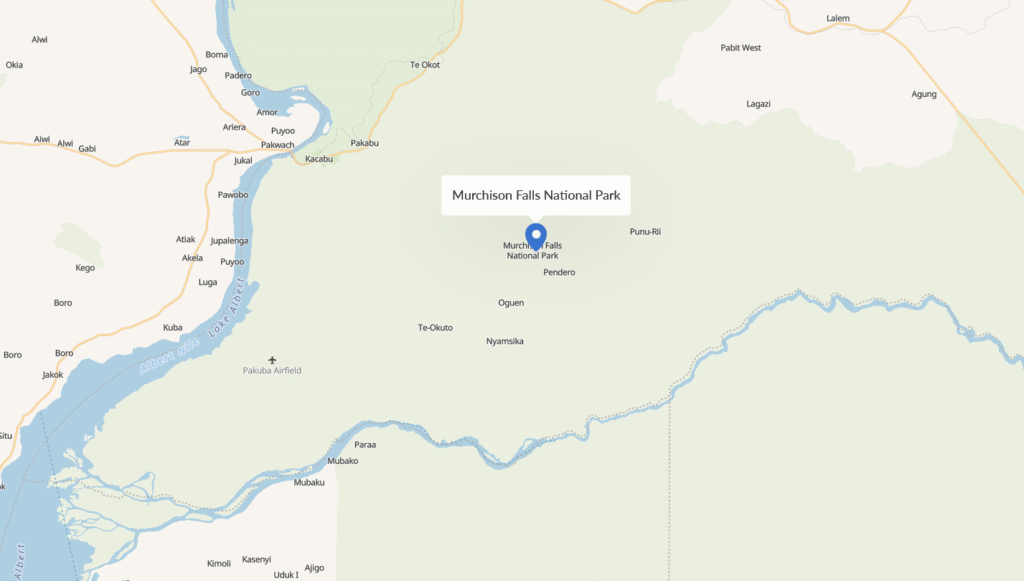
By road – From Kampala (the capital city), the park is approximately 313 km, which takes about 5 to 7 hours via the route: Kampala to Luweero to Masindi to Murchison Falls, depending on traffic or journey breaks.
Most travellers prefer to travel by private vehicle, tour van or organised safari vehicle.
Or one can opt for public transportation, as buses run from Kampala to Masindi town. Then, from Masindi, taxis or tour vehicles travel to the park headquarters or Paraa area, which is the main gateway for Safaris.
By air – Domestic flights from Entebbe International Airport to Pakuba or Bugungu airstrips take about 1 hour, that is after followed by a short drive to lodges or park entrances.
What to expect and see
Murchison Falls National Park is famed for its dramatic waterfalls, wildlife diversity and scenic landscapes, for instance,
Murchison Falls, a breathtaking natural phenomenon where the Victoria Nile squeezes through a 7-meter-wide gorge before plunging 43 metres into a pool below.
Wildlife that includes Lions, Elephants, Giraffes, Buffalo, Leopards, Uganda Kob, Hartebeest, Warthogs and Hippos.
Birdlife of over 450 species, including shoebills, fish eagles, hornbills, and vultures.
Rivers and wetlands, as the Nile small streams and papyrus swamps, attract diverse wildlife and provide excellent safari opportunities.
River Nile views as you get opportunities to explore the Nile by boat while spotting hippos, crocodiles and water birds
Scenic savannah and woodlands with rolling plains dotted with acacia trees that are ideal for game drives and photography, while you’re at it.
Activities
Game drives at dawn or dusk, where you spot large mammals, predators, and antelope herds.
Boat cruises along the Nile River from Para to the base of the falls, which is ideal for seeing hippos, crocodiles, and birds.
Hiking to the falls, as trails lead to the top of the Murchison Falls for panoramic views and photography.
Bird watching is exceptional for spotting rare and endemic bird species along the Nile and wetlands.
Take part in fishing and canoeing in selected areas that allow fishing for Nile perch or perhaps guided canoe trips.
Nature photography as you capture wildlife, river scenery, sunsets and iconic waterfalls.
Camping and lodge stays in various lodges and campsites that provide close access to wildlife and river views, all for you to take in.
Cultural encounters with visits to nearby communities to learn about local traditions and lifestyles of the local natives.
Murchison Falls National Park facts
- As a game reserve, Murchison Falls National Park was gazetted in 1926, then in 1952, it was declared the first national park in Uganda by the colonial British administration.
- Under the Royal Geographical Society (RGS), in 1862 John Speke and James Grant were the first europeans to visit Murchison Falls.
- The traditional and former name of Murchison Falls National Park is Kabalega National Park, named after the Omukama (King) of the Bunyoro Kingdom, Omukama Chwa II Kabalega (1853-1923).
- In 1864, the British explorer Sir Samuel Baker (1821-1893) named the Murchison Falls after the sponsor of his exploration, Sir Roderick Murchison (1792-1871), who was the president of the Royal Geographical Society.
- The Murchison Falls is the largest (3,840 to 3,893 square kilometres) and oldest National park (1952) in Uganda.
- The park features a combination of Savannah, woodlands, wetlands and riverine habitats, thus creating a highly diverse ecosystem.